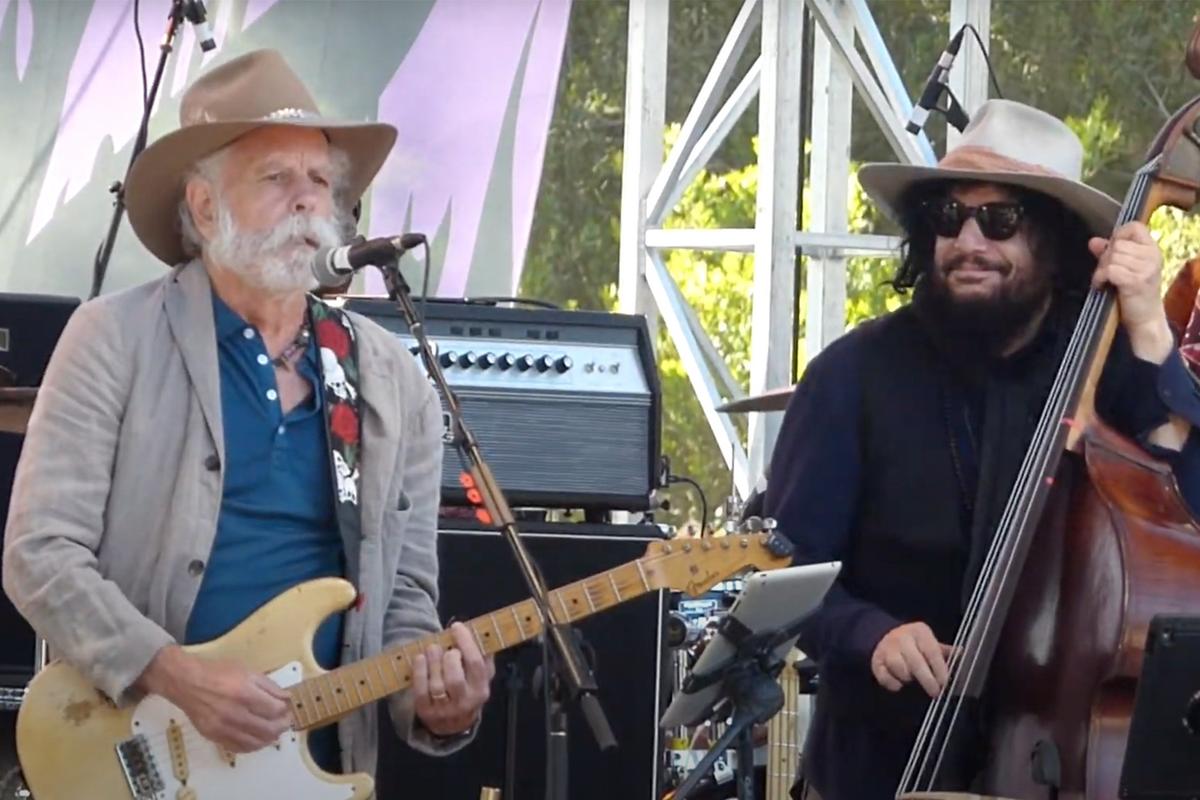

Bob Weir worked with a variety of players and projects in his final years, including regrouping with some of his former Grateful Dead bandmates for numerous tours.
His final live performances prior to his recent passing happened in August of 2025 with Dead & Company, the collective he formed in 2015, which initially featured fellow Dead alums Mickey Hart and Bill Kreutzmann alongside John Mayer on guitar and vocals, former Allman Brothers Band bassist Oteil Burbridge on bass, percussion and vocals, plus keyboardist Jeff Chimenti.
For most musicians with a career like Weir enjoyed, a single project like Dead & Co. would be enough to ride out the glory years. But the guitarist had an ongoing enthusiasm for making and playing music — as you can see from the many artists who have paid tribute to him in the wake of his death.
Legendary producer and bassist Don Was was the person who connected Weir with Mayer, planting the seeds for Dead & Company’s eventual birth. But he’d also unexpectedly end up playing in a band with Bob himself. Weir, Was and drummer Jay Lane (who eventually replaced Kreutzmann in Dead & Co.) joined up for a new project in 2018.
Bobby Weir & Wolf Bros. was the moniker that the trio used and it proved to be an endeavor which found the Grateful Dead cofounder adding and expanding his vision to include Chimenti on keys and multi-instrumentalist Greg Leisz on pedal steel guitar. Eventually, they added a horn and string section (the “Wolfpack,” of course) and played a set of shows as part of Willie Nelson’s Outlaw Music Festival.
The lineup of players remained fluid as more bookings appeared on the calendar. By 2022, they’d branched out further to perform concerts with full symphony orchestras and as Was shared on the evening of the news of Weir’s passing, the pair had been discussing plans to do more things together here in 2026.
Was is currently on the road with his excellent Pan-Detroit Ensemble, paying tribute to the Dead’s Blues for Allah, which turned 50 last year. The concerts, which began this past October, will take on a different tone as the tour continues forward.
The group began the next leg of the Blues for Allah trek last weekend with four shows in Ann Arbor, Michigan and dates are currently set to continue through mid-February.
During a 2022 conversation with UCR, Was shared the story about his collaboration with Weir and how it was evolving. Clearly, he was having a lot of fun working with Weir, who was finding fresh ways to interpret the work from his long career, both with the Dead and beyond.
What you’re doing with Bob and the Wolf Bros. seems like such a special collaboration. How have you seen yourself evolve as a player, working with Bob?
Well, a whole lot. You know, I was really intimidated, just to follow Phil [Lesh] and Rob Wasserman, who in their own ways, are virtuosic melodists. They’re very lyrical and I don’t play that way. I thought, “This is going to sound like a bar band covering Dead songs.” I was worried about it, but I soon learned that Bob didn’t want me to play that way. He wanted it to be intimate and he wanted me to play less.
Over a period of time, the challenge has been, how little can you play and still be helping the song? The challenge is to find the perfect note and don’t mess it up. It’s really helped me work with singers. It’s impacted everything I’ve done. What I try to do now is I try not to play when he’s singing. Like, not to play. Just hold a note. And if there’s a chord change that has to be emphasized on the low end, just play whole notes — and then answer and try to give him something that he can work off of. But don’t step on his phrasing.
That’s a work in progress, man. Every night it’s different. We play the songs differently every night. The one thing that I do know is that if something worked the night before, don’t do that — because the song’s definitely going to be different than it was the night before. You approach each night and each song with a beginner’s mind. We don’t come roaring in, 1-2-3-4, BOOM. We hold the chord until we see what we’re going to settle into. When it feels like we’re someplace, it starts to flesh out and then he starts singing when he’s comfortable. It’s been a great lesson in improvisation and restraint and taste.
Listen to Bob Weir and Wolf Bros.’ ‘A Hard Rain’s A-Gonna Fall’
Hearing things like “A Hard Rain’s A-Gonna Fall,” there’s so much interesting history bundled into the set list that goes far beyond the catalog of the Dead’s own songs.
Yeah, well it’s not out of line with the kind of solo shows Bob has done outside of [the Grateful Dead]. If you go back and look at Ratdog’s set lists, there’s a [Bob] Dylan song in there — or two. We try stuff all of the time. One day, we started playing [Donovan’s] “Sunshine Superman.” At soundcheck, I was just playing the lick on the bass and Bob started singing. He said, “Yeah, let’s do that thing!” It baffled the fuck out of people. [Laughs] I wouldn’t say it went over good. It was met with confusion, but it was fun!
What’s the Dead stuff that you’ve really come to appreciate?
The stuff that drove me crazy at the beginning. I remember being angry learning “Lost Sailor” and “Saint of Circumstance.” It seemed unnecessarily complicated. I was writing the charts out and it was like, “Why does there have to be a bar of nine right there?” [Laughs] They were hard to learn, but once I learned it, oh, it flows so beautifully, man. Everything is there for a good reason. That medley, it takes you for a ride. Every night, we hit something incredible with it.
Listen to Bob Weir and Wolf Bros.’ ‘Lost Sailor / Saint of Circumstance’
I remember on the first tour, we hadn’t done “Lost Sailor” and “Saint of Circumstance” for a couple of weeks. When we got to it again, I [realized that I] missed the song. It was like the songs were becoming friends. I’ve never experienced that before. It was like, “Oh, man, it’s great to see you! What do you want to do today? Where should we go?” [Laughs] That keeps coming back — they start living inside of you. Grateful Dead songs are like masterpieces, man. You don’t necessarily know it until you get inside — from the outside, that’s not necessarily evident. The Deadheads know. I think that’s why people come to the shows. They come for the songs.
You’ve mentioned that you’re about to rehearse with the guys. With yourself and Bob and the other members, you are all people who have been playing shows on the road for a long time. What does rehearsal involve at this point?
They involve remembering how to play with each other. Because remember, when he plays with Dead & Company, it’s the same songs, but it’s a whole different chemical blend. I’m not talking about drugs. [Laughs] But we played as a three-piece, we did a benefit gig in Bend, Oregon last Saturday, just Jay Lane and Bob and myself. We hadn’t done that in years…I mean, really, like three or four years.
About halfway through the show, I thought, “Alright, now I remember how we do this and how the [musical] conversation works when we’re a trio. So that’s the rehearsal. Yesterday, we rehearsed and we were just jamming on stuff. It’s more about just getting used to listening to each other and reacting. We know the songs. It’s just getting used to playing with each other again.
READ MORE: Bob Weir’s Last Concert Was a Joyous Celebration of Grateful Dead
Grateful Dead Albums Ranked
Even the band’s most ardent supporters admit that making LPs wasn’t one of their strengths.
Gallery Credit: Michael Gallucci


