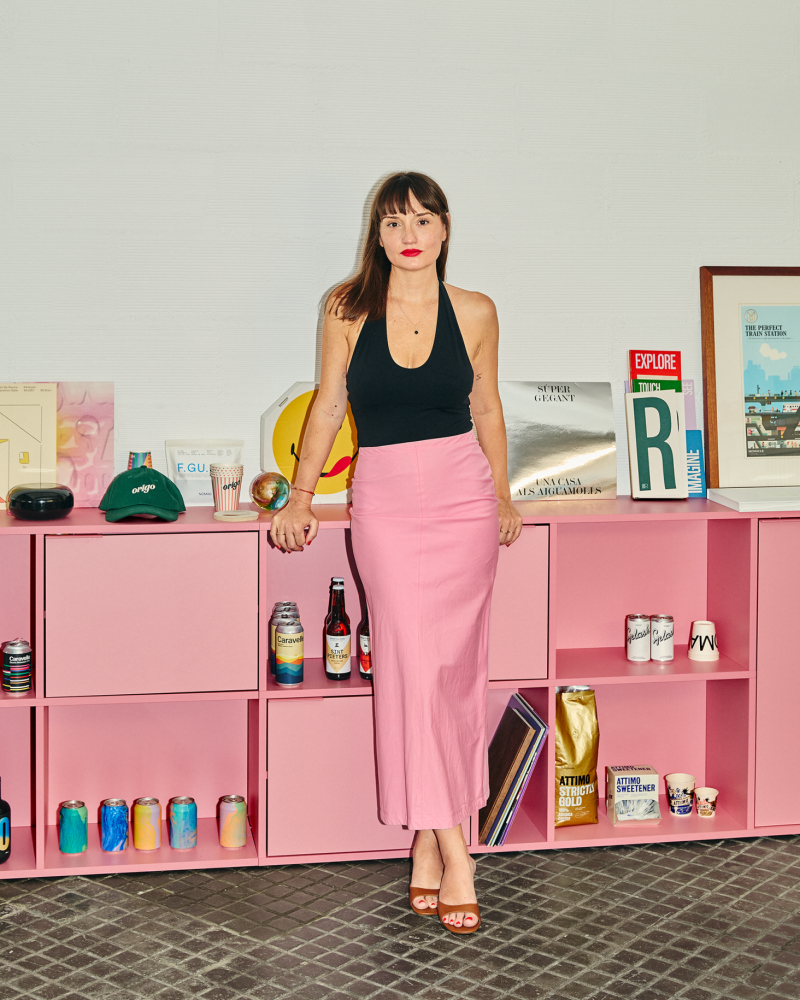
When Verónica Fuerte compares her 18-year journey running Hey Studio to the career trajectory of Britney Spears, you might think she’s joking. She’s not.
Speaking during a session on The Studio (our free networking platform where creatives can connect, collaborate and join live conversations like this one), the Barcelona-based creative director and founder says: “When I started Hey Studio, I felt very young with a lot of energy but naive, surprised by all the experiences. Through the years, I think I had the same feeling as Britney. Sometimes, maybe once a year, I wanted to kill my clients. I think all designers feel like that. But today, like Britney, I’m still here, still surviving. Next year, the studio will be 20 years old.”
She pauses, she smiles. “We rise, we fall, we reinvent ourselves.”
It’s the perfect metaphor for Hey Studio, which has spent nearly two decades refusing to play it safe; rejecting trends and insisting that the future of design lies not in chasing the next big thing, but in understanding what came before.
And in 2026, as AI promises to radically lower the barrier to design, Verónica’s commitment to craft, chaos and the human touch feels more important than ever.
The case for imperfection
Verónica’s design philosophy crystallised early. Studying in Barcelona over 20 years ago, she discovered the ornate, handmade lettering of the Victorian era and the Modernist response that followed.
“When I discovered this style, I felt: this is what I want to do”, she recalls. “I want this style to be universal, to be for everybody.” Her goal in founding Hey Studio in 2007 was simple but ambitious: “To democratise design. Design is for everybody, not just for a specific target. It needs to be meaningful and also accessible.”
That philosophy manifests in unexpected ways. Take the Daydream project, a CBD-infused sparkling water brand. Rather than digitally create the marbled effect (which would be faster, cheaper, and more controllable), Hey Studio applied a real marbling technique directly to each can design.
“Many people told me you can create this texture with a filter or with Photoshop,” Verónica recalls. “But if I do it with software, I will for sure try to be perfect, trying to find the best detail, the best colour. I wanted this randomness, which is what makes this project special. It’s not perfect in a way, because for me, perfect kills the soul.”
It’s a philosophy that extends across the whole of Hey Studio’s work. For a wine competition project, the team hand-scratched 1,000 silver-covered books, each one unique. For Ola Coffee, they created limited-edition boxes using silk screen and hand-applied vinyl, transforming packaging into frameable prints. When a printer says something’s impossible, Verónica has learned, “it’s possible, but they are a little bit lazy sometimes”.
The AI paradox
This commitment to craft puts Verónica in an interesting position as AI tools proliferate. She’s refreshingly candid about the tension. “Right now I feel I’m in between paradise and hell,” she says. “I really enjoy AI, and I think it makes me feel the best version of myself, because I’m better and faster. I can make everything myself without others, and this is good. But at the same time, I know that the future is complex.”
Her approach? Embrace it all. “Try everything you have: AI or techniques from the past. Know a lot of things. The more things you know, the better designer you will be.” At the same time, she’s clear about the limitations. “What AI makes very nice is fiction. But authenticity is our part, made by humans.”
It’s a distinction that matters more as budgets tighten and timelines accelerate. Verónica notes that clients are increasingly seeking out smaller, independent studios precisely because “it’s the only way to be memorable, to find very authentic people. Maybe big agencies have a more neutral style; not this unique style, which is more for independents who are not only focused on benefits.”
The personal is professional
Ten years ago, Verónica faced a crisis. A difficult divorce forced her into therapy – “therapy saved my life,” she says – and fundamentally changed how she approached her work. The experience led her to found Women at Work, a podcast now entering its sixth season, that gives voice to women across the creative industries.
“I had a company that many people know, so I was like: I need to do something, not just for me, for everybody,” she explains. The podcast embodies a quote from one of her guests, designer Astrid Stavro: “There are a lot of women in design. You’ve just never heard of them.”
That commitment to visibility and community extends to her team. Hey Studio currently comprises six people, all women; though Verónica insists this is a coincidence rather than policy. “At times, it was half men, half women,” she notes. What matters most to her is aptitude as much as talent: “In an interview, it’s not easy to find that, but I have my own questions that I try to understand a little bit the person, and also my experience; I’ve developed an intuition through the years.”
The cost of authenticity
Verónica is frank about the economics of passion work. When asked how she balances creativity with profitability, especially on labour-intensive handmade projects, she’s pragmatic. “I show mostly the handmade things because they’re the most beautiful to explain,” she says. “Of course, it’s not everything. You need to have a balance. If everything is the projects I just showed you, there are no salaries.”
Her dream project? “I would love to do a big brand that’s worldwide, like a trophy piece,” she says. But she’s equally energised by the electric vehicle company that called yesterday, the sunglasses commission that took three years to produce, and the watch project that required the development of new manufacturing techniques.
Designing for tomorrow
As the session draws to a close, Verónica distils her philosophy into this principle: “The only way to create is by being curious, understanding our history and knowing the past. Only then can we truly innovate.”
It’s advice that seems timely, in an industry increasingly seduced by the speed and ease of AI-generated content. But Verónica’s 18-year track record and her studio’s instantly recognisable visual language suggest she’s onto something.
The designers who survive won’t be the ones who can prompt-engineer the fastest. They’ll be the ones who understand marbling techniques from before Christ, Victorian typography, modernist principles and yes, how to code a website. They’ll be the ones willing to hand-punch 500 confetti holes, to spend three years perfecting a watch mechanism, to insist that randomness and imperfection aren’t bugs but features.
“I always loved craft,” Verónica says. “Craft is our legacy, and it’s important to keep that in mind because AI doesn’t know craft. Craft is all about the details; what you use, what colour, what typefaces. So many things that make a good designer an excellent designer.”
As for those clients, she occasionally wants to kill? “It’s part of our work to convince the clients that risk is the good one,” she replies. And after 18 years, enough clients have taken that risk to prove her right.


