
Many creatives get described as restless. The adjective is usually a sort of synonym for ‘prolific’, or sometimes ‘shapeshifting’ – occasionally, it’s a euphemism for a certain degree of iconoclasm, controversy even.
Any and all of these descriptors – and many more – could be applied to Swiss artist Luciano Castelli. This becomes apparent not just through his vast and multifarious body of work, but through even a brief conversation with him: in under an hour, and even with the occasional language barrier, our chat hurtles from Butoh to Brian Eno; from pirates to paint pigments; artist as rockstar to artmaking as compulsion – for better or worse.
Safe to say, it seems as though Castelli rarely sits still. We spoke around the opening of his new exhibition, Whispers of Japan, at Basel-based art foundation Kulturstiftung Basel H. Geiger (KBH.G for short).
As the title suggests, the show delineates Castelli’s longstanding fascination with Japanese culture, an interest that’s all part of his obsession with fairy stories, he says.
“I made a lot of fairytales in the 1980s,” Castelli explains. “I like to play these different roles, or jump into different feelings. I especially like Japan for its culture – its theatre and its masks. I like the style of the people – it’s very elegant.”
The Bitch and Her Dog
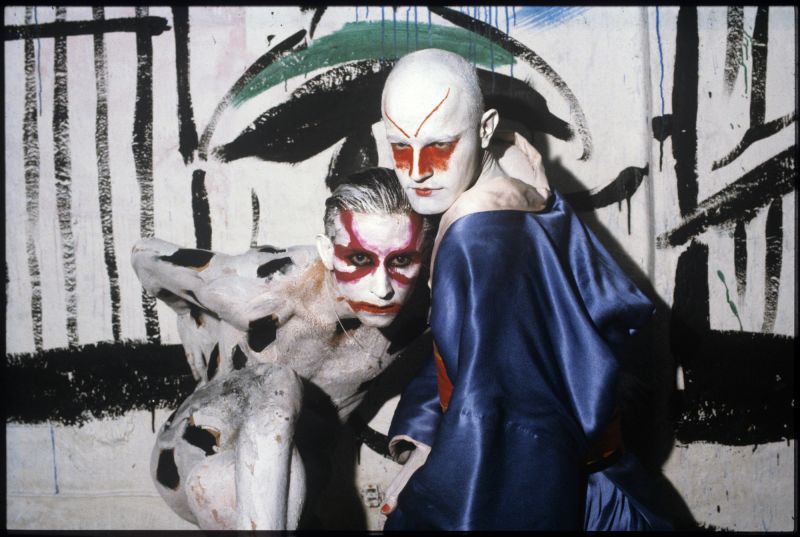
One such ‘fairytale’ of sorts – though probably not a kids’ bedtime story – is The Bitch and Her Dog, a 1981 performance collaboration with artist Salomé that began life as a performance and went on to spawn a series of stunning paintings.
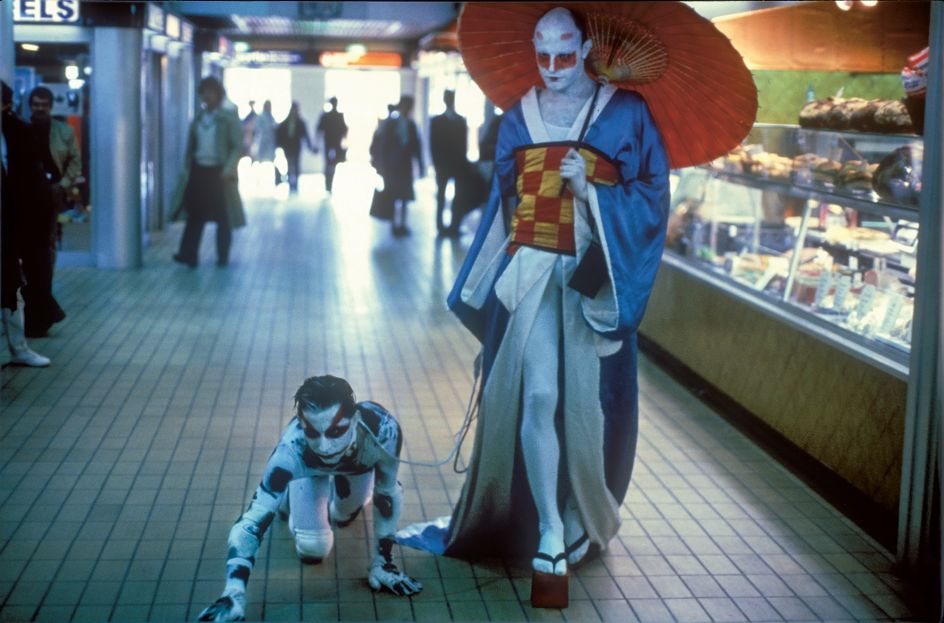
Luciano Castelli & Salomé, The Bitch and her Dog, Performance in Lyon, 1981. Photo: Helmut Metzler
Shown on video at KBH.G, the performance piece debuted at a performance art festival in Lyon in 1981 in which Salomé as ‘bitch’– face painted in thick white and red makeup-cum-warpaint, and decked out in a kimono and some precarious looking traditional Japanese-style platform sandals (known as Geta) – is seen walking Castelli as ‘dog’, led about on all fours like the whole thing is a perfectly normal way of navigating French public transport, ascending escalators, or strolling in a nicely manicured garden square.
“The idea for us was always to make our projects a little scandalous,” he says, acknowledging the bizarre and not subtly fetish-adjacent nature of the public performance and the work’s title. “It’s much nicer, I think, to perform out in public than to make it in the museum.” Surely it was painful?! “I nearly lost my knees!” Castelli retorts.
Castelli and Salomé’sSalomé’s relationship, both artistic and personal, was clearly something rather special. In 1980, the pair formed a rather brilliant band called Geile Tiere (translation: ‘horny animals’) – a deliciously noisy post-punk/no-wave style confection that was all scratchy guitar sounds, obnoxious electronic beeps and stage shows that delighted in BDSM-esque costuming and gender-play and generally dancing with deviance.
To see this as a side show or a distraction from Castelli’s art practice would be to misunderstand his whole MO; however, his art is all about expansiveness – message over medium, experimentation over specificity.

Exhibition view, WHISPERS OF JAPAN – Luciano Castelli, Kulturstiftung Basel H. Geiger, 2025 Photo: Kulturstiftung Basel H. Geiger | KBH.G
Painter, performer, photographer, musician, filmmaker — the list is unwieldy because Castelli is unwieldy. He talks about “the freeness in the mind” as his greatest luxury: being able to wake up and decide, without hierarchy or guilt, to make a film, a painting, a piece of music, or to paint a ten-metre canvas. “My dream was never to have many houses,” he shrugs. “It’s more important that I can live from my work. That I can say every morning: What should I do today?”
Young Wild
The closest he’s been to the whole art-as-route-to-property-portfolio thing was with the Berlin-based neo-expressionist painter group that Castelli and Salomé were part of in the 1980s alongside Rainer Fetting, Bernd Zimmer and Helmut Middendorf. The group was dubbed the Junge Wilde, a moniker that has been said to loosely translate as ‘young fauves’ or, literally, ‘Young Wild’ – because that’s what they were: young and wild.
It makes a lot of sense that the group was linked to Fauvism, an early 20th-century modern art movement known for its intense, often non-representational colours; bold lines and shapes; “wild” brushwork; and an emphasis on emotional expression and subjective experience over realistic depiction.
Indeed, the work of Junge Wilde ticked these boxes, all the while serving as a uniquely of-its-time-and-place riposte to the conceptual, minimalist leaning approach of much art in the 1970s.
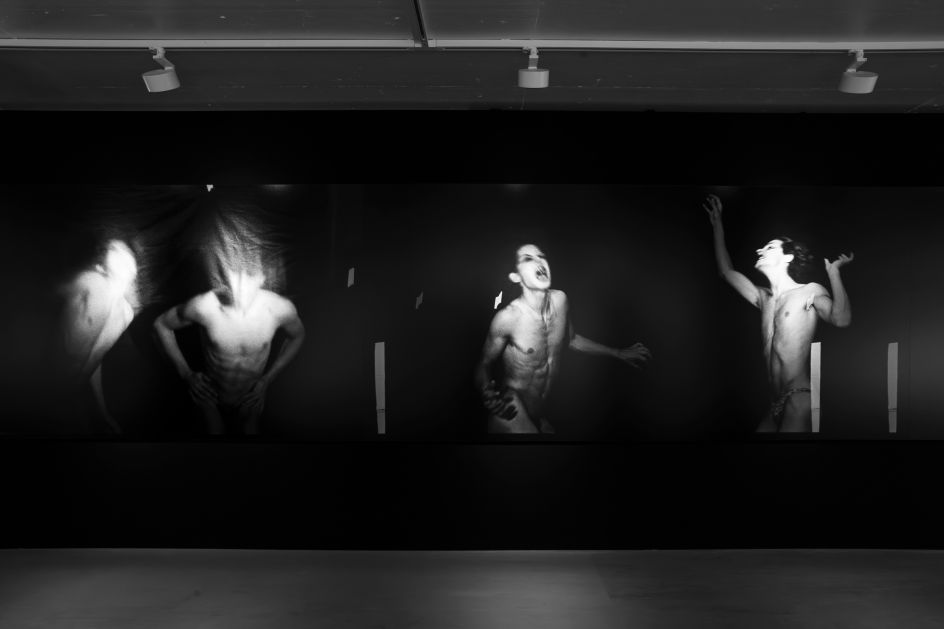
Exhibition view, WHISPERS OF JAPAN – Luciano Castelli, Kulturstiftung Basel H. Geiger, 2025 Photo: Kulturstiftung Basel H. Geiger | KBH.G
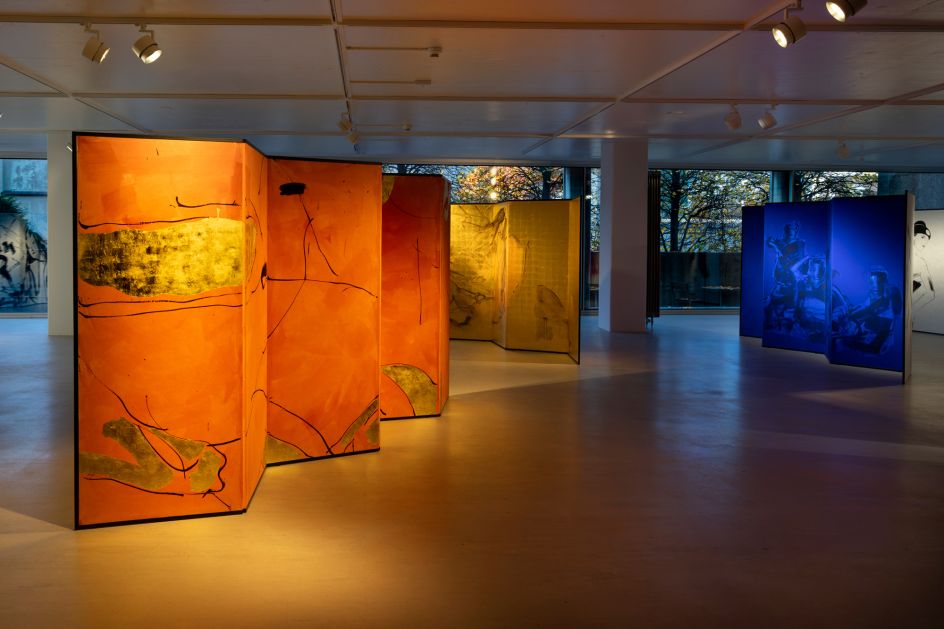
Exhibition view, WHISPERS OF JAPAN – Luciano Castelli, Kulturstiftung Basel H. Geiger, 2025 Photo: Kulturstiftung Basel H. Geiger | KBH.G
“We started with these ten-metre paintings,” he says. “Everyone was shocked, because they didn’t [consider] the possibility of doing it.” The group gained notoriety quickly; collectors from London and Switzerland snapped up works, and overnight the once-marginal painters were international names.
“In the ’80s we felt like rock stars,” Castelli says – and he isn’t joking, or exaggerating. “Sightseeing buses passed before our houses… we were always signing our names… It was crazy, but it was fun.”
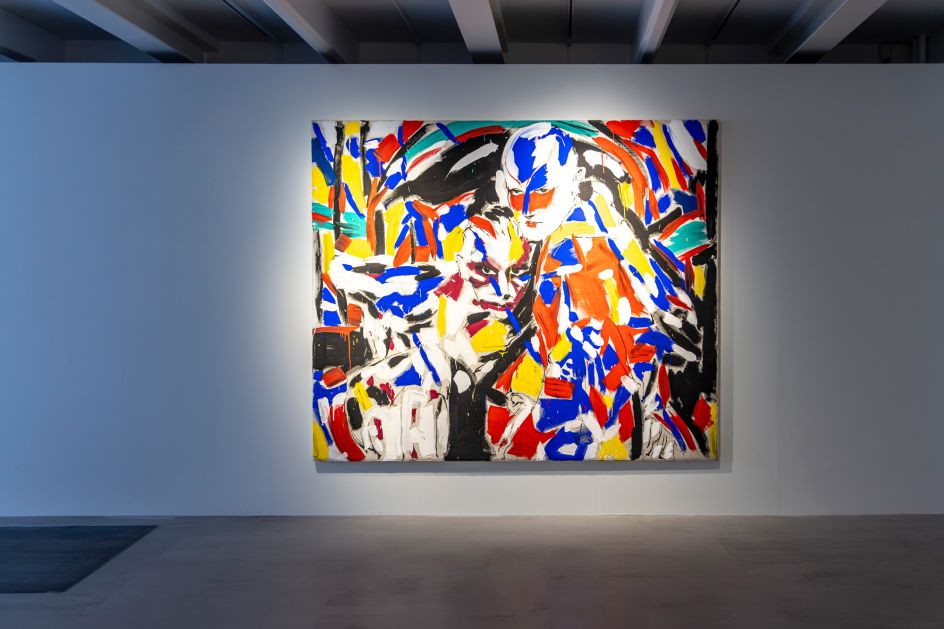
Castelli’s Junge Wilde era is represented in the show by pieces like the stunning 1981 painting The Bitch and Her Dog, as vibrant in the exhibition today as it was four decades ago – it almost vibrates with the immediacy of its pure pigments.
“In this time I liked pure colours,” Castelli says of the deliciously vibrant, striking 1981 painting The Bitch and Her Dog, as vibrant in the exhibition today as it was four decades ago – it almost vibrates in the immediacy of its pure pigments.
Painting paravents and the ‘dance of death’
At the KBH.G show, 1980s works like these dovetail into a room showcasing new pieces created this year and last that sit in dialogue with their older counterparts. These new works see Castelli painting on ‘paravents’, a French term often used to describe modern versions of traditional Japanese folding screens usually used as room partitions.
Exhibition view, WHISPERS OF JAPAN – Luciano Castelli, Kulturstiftung Basel H. Geiger, 2025 Photo: Kulturstiftung Basel H. Geiger | KBH.G
Continuing the tradition of his spectacular performances – such as at the Kaufhaus Jahndorf in Berlin or in 2016 at the SPSI Art Museum in Shanghai, where he spontaneously painted the entire museum interior – Castelli deliberately pushes the boundaries of conventional art presentation with the paravents. The result is an intense, atmospheric experience in which painting, sculpture, self-portraiture and craftsmanship seamlessly merge.
It’s a recent example of the artist’s continual pursuit in finding new approaches to painting: on the paravents, he delights in everything from the power of a single colour, such as a rich gold or that distinctively light-gulping shade, Yves Klein Blue, to contemporary explorations of his signature self-portraiture, to calligraphic-leaning paint gestures and more.
Spanning a huge wall on one side of the paravents room is a never-before-seen photograph-turned-mural depicting Castelli’s explorations of Butoh, a Japanese form of dance-based theatre born after the Second World War, sometimes dubbed the “dance of death”. It’s a beautiful addition to the more sculptural new works, and one that’s truly moving – both literally and figuratively.
Castelli began photographing his own interpretations of Butoh in the 1980s, captivated by its philosophy of movement emerging from within rather than being choreographed from the outside. “You don’t have shadow without light,” he says. “Butoh is not a dance like in our theatres. It comes from inside. You must show the spontaneity of what you feel.”
Forgetting the ego
Castelli’s interest in self-portraiture emerged in the 1970s, when one of his pieces in which he plays with double exposure – two selves, interacting with one another – was shown in the seminal 1974 exhibition Transformer at Kunstmuseum Lucerne (the show title a direct reference to Lou Reed’s equally groundbreaking 1972 solo record of the same name). The group show explored travesty, drag, and gender play at a moment when such ideas barely had vocabulary, and Castelli was one of its young Swiss participants, alongside artists like Jürgen Klauke and Urs Lüthi.

Exhibition view, Home Is a Foreign Place – Sandra Knecht, Kulturstiftung Basel H. Geiger, 2025 Photo: Kulturstiftung Basel H. Geiger | KBH.G
For Castelli, self-portraiture wasn’t narcissism so much as a strategy — a way of splitting himself into multiple modes, overlapping versions of the self like translucent ghosts. “It’s not that I like myself so much,” he says. “But in art, it’s very nice when I can play with representations of myself. It’s like having a conversation with me.” The images look contemporary even now; at the time, they were revelatory.
Castelli’s son recently asked him how he manages to “go outside of himself” in works like those Butoh photos. “Maybe it’s like painting, when you forget everything like your ego, and let the energy through,” Castelli explains. “You jump into it.”
Indeed, if there’s a throughline that connects all that he does, it’s that sense of energy – the ‘jump’. His brushstrokes feel totally kinetic and alive in their big, unabashed, gestural flourishes.
His relentless sense of movement in both life and works suggests that, despite an art career spanning more than 50 years, things are unlikely to slow down: for Castelli, it seems, making art is as much a compulsion as a career.
“I can’t stop,” he says at one point, laughing. “If I’m on the beach, I collect wood. I have to do something. When I lived in Berlin, I worked like crazy. At night, I filled the whole studio, then in the morning, I came in, put everything away, and I could start again. It’s a little like a sickness.”


