Something’s been happening in advertising for a while now, and the new Domino’s campaign is a good moment to examine it honestly. Absurdism—proper, committed, logic-free absurdism—has quietly become the default register for a significant portion of mainstream creative work.
Old Spice showed that a man on a horse delivering non-sequiturs could shift product faster than any rational benefit claim. Compare the Market built an empire on meerkats. Cereal brand Surreal grew a cult following through deadpan OOH copy that refused to explain itself. And now Domino’s is summoning Mexican wrestlers into people’s living rooms.
So the question is: does this represent genuine creative thinking? Or has the industry simply found a reliable trick only to run it into the ground? The answer, in the case of CHICK ‘N’ DIP at least, is more interesting than either option suggests.
Adding character
Domino’s new chicken concept launches across nearly 1,400 UK stores, with a campaign from VCCP featuring boneless bites, wings and tenders alongside nine globally inspired dips. The brief was to make the launch feel as immediate and energetic as the product itself. The answer, developed by VCCP creatives Adam Jackson and Ted Price, was to give each dip its own summoned character.
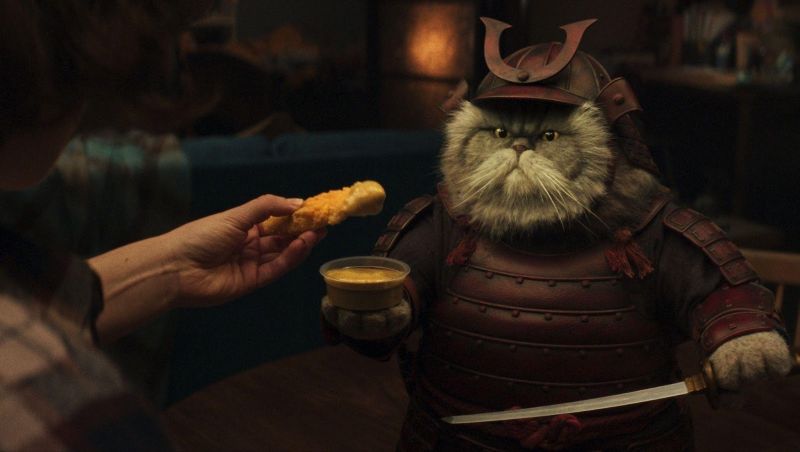
Ask for the Mexican Mayo to be passed over, and you’ll find yourself sharing your sofa with a pair of Mexican wrestlers. Reach for the Ghost Chilli Dip, and a ghostly organist appears behind a flame-throwing organ. The Katsu Curry Dip produces a somersaulting samurai cat. The Buffalo Hot Dip: a charging buffalo.
It is, on the surface, exactly the kind of campaign the industry now produces with reliable regularity. Surreal scenario. Heightened domestic setting. Creatures and characters that have no business being where they are. Knowing wink to the audience. The template is familiar enough that you could almost set your watch by it.
When absurdism earns its keep
The more useful question, then, is not whether a campaign is absurdist but whether the absurdism is doing real work. And here, I’d argue, it is.
Dips are, by their nature, a sensory proposition: they’re about flavour intensity, about the experience of tasting something unexpected. That’s genuinely hard to communicate in a 30-second film without resorting to food-porn close-ups or leaning heavily on voice-over. Characters sidestep the problem entirely by externalising the sensation. You don’t need to show what Katsu Curry tastes like if a samurai cat can show up and embody it.
There’s also a memorability logic at work that goes beyond mere entertainment. Nine dips is a lot of product information for a consumer to hold. Nine distinct characters give each dip a hook that a flavour description alone couldn’t provide. The creative work is doing the job of the menu, and that’s not a trivial achievement.
The sub-brand problem
There’s a structural challenge underpinning all of this that the absurdist surface can obscure. Launching a sub-concept under a dominant brand is one of the trickier things you can ask a creative agency to do. Do too little and the new thing disappears into the parent brand’s shadow. Do too much, and you dilute the equity that made the parent brand worth extending.
Marketing director Harry Dromey is candid about what’s at stake: “The Domino’s name brings a huge amount of fame, credibility and love,” he says. “Launching CHICK ‘N’ DIP with its own distinct identity increases visibility and relevance for Domino’s in one of the fastest-growing food categories.”
The characters are the solution to that problem. They give CHICK ‘N’ DIP enough identity to feel like its own thing, without requiring the campaign to build an entirely new brand from scratch.
Separately, the CHICK ‘N’ DIP visual identity was developed by Domino’s in-house creative department, Big Dip Studio, drawing on global travel and street-food culture. It’s a wise structural decision that gives the sub-brand its own visual world, and lets the campaign focus on personality rather than establishing credentials.
Is it an addition?
So is advertising addicted to absurdism? Probably, in the same way, it was once addicted to emotional storytelling, and before that to celebrity endorsement, and before that to rational benefit claims. Trends in creative work are real, and the industry does have a tendency to chase what’s working until it stops working.
The risk with absurdism, as with any register, is that familiarity breeds not contempt but invisibility; that the buffalo stops being surprising because there’s always a buffalo somewhere.
What saves the best of this work, and what saves CHICK ‘N’ DIP, is that the strangeness is specific rather than generic. These aren’t random creatures deployed for chaos. They are precise answers to precise creative problems, and the craft visible in the execution—the commitment, the detail, the deadpan domestic framing—is what separates them from the merely weird.
Harry describes the logic simply: “No longer will families be torn apart or marriages end by arguments over whether to order chicken or pizza. You can have both, delivered in 25 minutes.”
And to my mind, when the narrative is that clear, a charging buffalo stops feeling like a trend and starts feeling like an answer.


